

Quick Answer Box: What a failed file audit actually costs an affordable housing owner is rarely one clean number. Expect disallowed credits for the year under review, recapture plus interest on earlier years, staff hours spent rebuilding documentation, and civil money penalties reaching $48,833 per violation for Section 8 owners under federal rules.
A failed file audit means a monitoring agency reviewed your tenant files and documented noncompliance in writing. What a failed file audit actually costs an affordable housing owner depends on the program. Section 42 properties face credit disallowance and recapture. Section 8 properties face repayment demands, review ratings that follow the asset, and penalties that cannot come out of project income.
Why Do Audit Findings Happen During Compliance Monitoring?
Most audit findings come from paperwork, not fraud. Treasury regulations require state agencies to inspect every building in a project and review the certifications, the supporting documentation, and the rent records for at least 20 percent of low-income units at least once every three years. Units get sampled at random. One missing verification becomes a reportable finding.
The sample size is not fixed, either. The IRS guidance tells agencies to expand beyond the 20 percent minimum when they see poor internal controls, multiple problems, or a significant number of households that are not income-qualified. A weak first sample invites a bigger second one.
Tenant File Errors That Trigger Tax Credit Compliance Findings
Form 8823 carries seventeen categories of noncompliance, and the ones tied to tenant file errors dominate. Household income above the limit at initial occupancy. Recertifications completed incorrectly or not documented. Student status not verified. Utility allowances never reviewed annually. Gross rents that quietly drift above the ceiling after a HUD income limit release.
Tax credit compliance is not always as rigid as owners fear, though. The IRS guide directs agencies to weigh incomplete documentation against the surrounding facts, and it allows managers to perfect a file where the certification was timely signed but an employer verification went missing. Credible oral testimony counts when a tenant has moved out and cannot be reached.
There is one deadline that matters more than any other. Noncompliance the owner identifies and fixes before the agency sends notice of an upcoming review does not have to be reported at all. The IRS treats that notification letter as a bright line. Everything caught after it is a finding. Everything caught before it is just good financial management and file discipline.
HUD Violations That Surface in a HUD Audit of Your Files
For subsidized properties, the review is a Management and Occupancy Review, and the instrument is Form HUD-9834. Reviewers work through leasing and occupancy, tenant relations, maintenance, and general management practices, then assign an overall rating of superior, satisfactory, below average, or unsatisfactory under Chapter 6 of HUD Handbook 4350.1.
The written report follows within 30 days and cites findings, HUD violations, and required corrective actions with target dates. Owners get 30 days to respond, which is a short window for any operator without documented site-level operating procedures already in place. A below average or unsatisfactory overall rating carries appeal rights, also on a 30-day clock. Miss those windows and you lose the cheapest chance you had to fix the record.

What Is the Real Compliance Risk After a Failed Review?
Compliance risk on a failed file audit runs in two directions at once: money you owe back, and attention you attract. The tax exposure lands on the ownership entity and its investor. The regulatory exposure lands on the operator’s track record, which shapes future allocations, refinancing conversations, and whether a syndicator wants your next deal.
| Cost Category | What Triggers It | Who Absorbs It |
|---|---|---|
| Disallowed credit for the review year | Nonqualified units found in the sample | Ownership entity and investor |
| Recapture plus interest | Units out of compliance in earlier credit years | Ownership entity and investor |
| Civil money penalty up to $48,833 per violation | Knowing, material breach of the HAP contract | Owner personally, not project income |
| File reconstruction hours | Missing verifications and unsigned certifications | Property operating budget |
| Expanded sample on the next review | Evidence of weak internal controls | Property operating budget |
Credit Recapture and Compliance Risk on the Tax Side
The IRS publishes an example worth memorizing. A 100 percent tax credit project with 100 units carries $3,000 of credit per unit. An agency samples 20 units and finds noncompliance in 15 of them. The IRS can adjust $45,000 of credit for the review year and recapture $15,000 plus interest for each prior year of the credit period.
Two details soften and sharpen that at the same time. The IRS cannot project sample results across the whole property, so 75 percent noncompliance in a sample does not disallow the entire credit. But every Form 8823 is analyzed for audit potential the moment it arrives, along with the taxpayer’s three most recently filed returns.
Correction Periods and Affordable Housing Compliance Deadlines
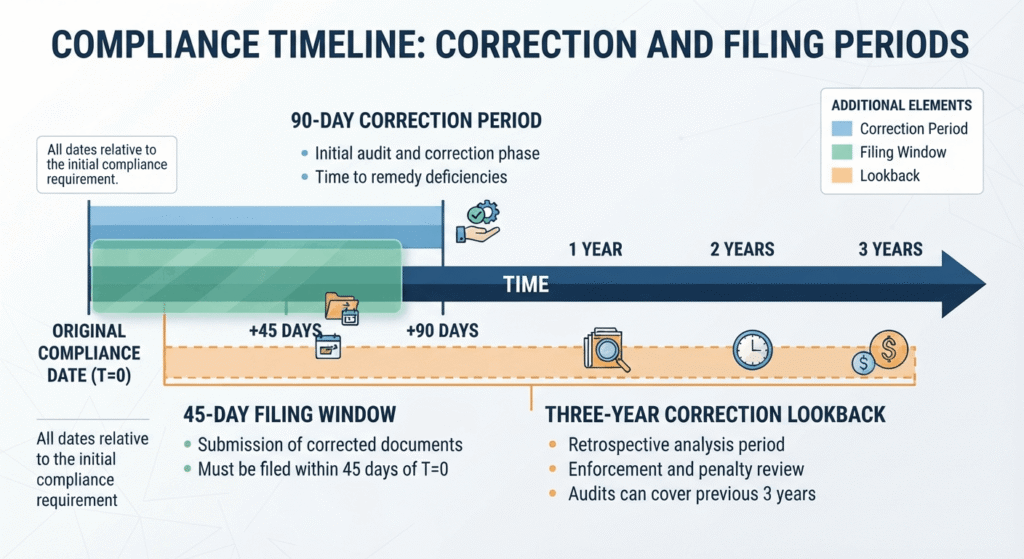
The correction period generally runs 90 days from the date of written notice, extendable to a total of six months for good cause. The agency then files Form 8823 with the IRS within 45 days after that period closes, whether or not you fixed anything. Correcting fast does not prevent the filing. It changes what the filing says about you.
On the subsidized side, HUD’s civil money penalty rules at 24 CFR Part 30 set a maximum of $48,833 per violation for Section 8 owners and $62,829 for multifamily mortgagors. Neither penalty may be paid out of project income. That is the line most owners have not read.
Frequently Asked Questions
1. How long does an owner have to correct findings from a failed file audit?
The correction period generally cannot exceed 90 days from the date the agency provides written notice of noncompliance. There is no minimum period. Agencies may extend it to a total of six months when there is good cause, but the extension is discretionary and must be requested.
2. Does fixing a finding stop the agency from filing Form 8823?
No. Once an agency identifies reportable noncompliance, it must file Form 8823 whether the owner remedied the issue or not. Fast correction changes the box that gets checked, so the form shows noncompliance corrected rather than an open finding. That distinction matters to the IRS.
3. What tenant file errors show up most often during compliance monitoring?
Reviewers repeatedly cite the same documentation gaps across affordable housing management portfolios:
- Missing or expired third-party income verifications
- Initial certifications signed after the move-in date
- Unverified full-time student status
- Utility allowances never reviewed on the annual cycle
- Asset certifications missing for households under the $5,000 threshold
4. Can a failed HUD audit affect the Section 8 contract?
A below average or unsatisfactory Management and Occupancy Review rating triggers required corrective actions with target dates, appeal rights within 30 days, and closer servicing attention. Where a breach of the housing assistance payments contract is knowing and material, HUD may pursue civil money penalties separately from the review process.
5. How long must affordable housing owners keep tenant files?
Tax credit records must be kept at least six years after the due date, with extensions, for filing the federal return for that year. Records for the first year of the credit period get held six years beyond the return due date for the final year of the compliance period.
Conclusion
Owners tend to price a failed file audit as a cleanup project. The real bill is recapture with interest, penalties that cannot touch project income, and a compliance history that follows the asset into its next allocation round. What a failed file audit actually costs an affordable housing owner is decided long before the agency arrives, in whether tenant files are built correctly at move-in and audited internally on a fixed schedule.
Compliance and risk management on a LIHTC, Section 8, or HUD-assisted community is not a once-every-three-years exercise. It is a monthly file review habit, and the owners who keep it rarely meet a correction period at all.