
Quick Answer: Utility billing and RUBS let apartment owners pass water, sewer and trash costs to residents by formula when units share a master meter. Recovery holds up when the lease explains the method, common areas come out first and residents never pay more than the utility billed. Unexplained charges are what push residents out.
Utility billing and RUBS have become a line owners watch every month. Water, sewer and trash prices rose 4.8% in the year ending September 2026, while rent of primary residence rose 2.8%, according to the Bureau of Labor Statistics. For apartment community owners on master meters, that gap comes out of net operating income unless some of it is recovered.
What Is Utility Billing and RUBS?
Utility billing and RUBS describe how an owner charges residents for utilities the property buys in bulk. RUBS, short for ratio utility billing system, splits a master-metered bill among units by a formula such as occupants, square footage or bedrooms. Submetering bills each unit for its own measured use instead.
How RUBS utility billing divides a master bill
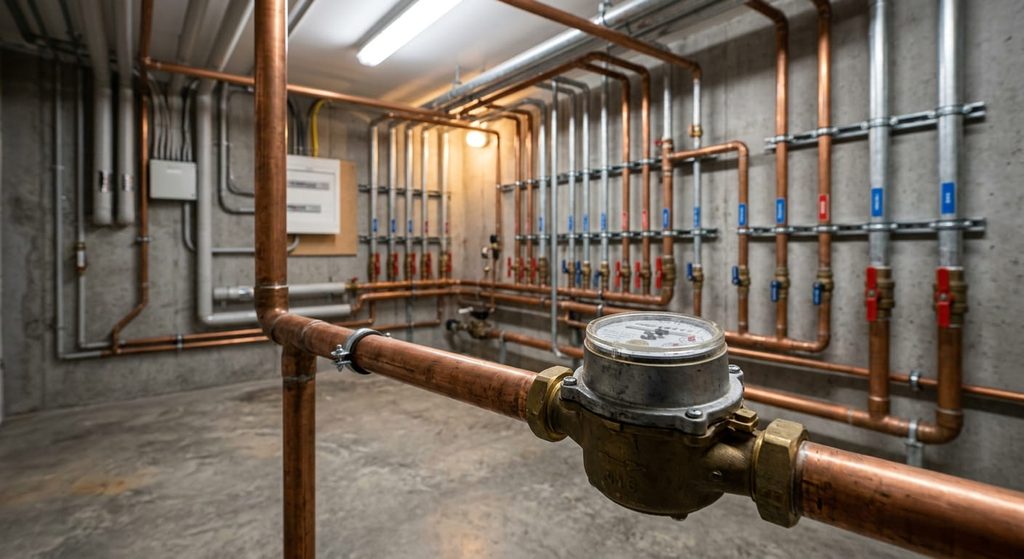
RUBS utility billing starts with the utility’s invoice for the whole property. Common-area use such as the pool, laundry and irrigation comes off first, and the rest is divided by the formula in the lease. EPA’s WaterSense metering fact sheet names square footage and occupancy as the usual factors and notes that rules vary by location.
In Texas, owners must register with the Public Utility Commission before billing residents for submetered or allocated water and sewer, and the commission’s rules list the formulas an owner may use.
Utility allocation versus submetering
Utility allocation recovers cost. It doesn’t change how much water people use. The EPA fact sheet cites a national study in which residents of submetered units used about 15% less water than those in unmetered units. That same study, funded in part by EPA, two apartment associations and 10 water utilities, found no measurable water savings from allocation billing.
So which one fits? A formula is cheaper to start. A meter rewards the resident who takes short showers, but it costs real money to retrofit.
Why Does Utility Cost Recovery Matter More in 2026?
Utility cost recovery matters more because utility prices are climbing faster than rent. In the September 2026 Consumer Price Index, water and sewer and trash collection rose 4.8% over 12 months, garbage collection 5.2% and electricity 4.4%. Rent of primary residence rose 2.8%. Utility billing and RUBS are how most master-metered owners close part of that gap.
Utility expense recovery on a modeled 200-unit property
Take a modeled 200-unit community with a $15,000 monthly master bill for water, sewer and trash, or $180,000 a year. A 4.8% increase adds $8,640 a year.
Now apply utility billing and RUBS. Base charges and common areas account for $3,000, which leaves $12,000 to allocate, or $60 per unit. With 10 units vacant, residents pay $11,400 and the owner keeps $600 a month for the empty units. That’s a 76% utility expense recovery rate on the full master bill.
Spreading the vacant share across the 190 occupied units would raise each bill to about $63.16. Check state rules first, and expect residents to notice when a neighbor’s move-out raises their bill. A vacancy share kept as an owner cost, on its own line in monthly owner reporting, is easier to defend.
How Do Owners Recover Utility Costs Without Losing Residents?
Owners keep residents through utility billing and RUBS by making the charge predictable and easy to check. Disclose the method before the lease is signed, publish the average bill, take out common areas, add no markup and let residents see the math. Disputes start with a charge nobody explained.
Billing transparency residents can check
Texas spells out billing transparency for utility billing and RUBS in detail. The PUC’s guide to allocated utility service requires the lease to describe the formula and state the prior year’s average monthly bill, along with the highest and lowest. Bills may include only water, wastewater and related surcharges, never the utility’s deposit, disconnect or late fees. Residents get at least 16 days to pay, and the late penalty is a one-time charge capped at 5%.
Colorado put similar limits into law this year. House Bill 26-1013, signed in March 2026, allows RUBS only when total tenant charges stay at or below the utility’s bill, no fee goes on top and common areas are excluded. Buildings with permits applied for on or after July 1, 2027 must have gas, electric and water metered directly or by submeter.
Where a vacant cost recovery fee fits
A vacant cost recovery fee covers a gap that utility billing and RUBS don’t. When a new resident doesn’t move the electric account into their name, the property keeps paying for that unit. Billing services match meter data to move-in dates, bill the resident for actual use and sometimes add a fee. Put the fee and its grace period in the lease, after checking state law, because some states bar charges above the utility’s actual bill. After that, unpaid utility charges follow the same collections policy as rent.
Flat rate utilities and all-bills-paid pricing
Flat rate utilities trade accuracy for simplicity. A fixed charge is easy to advertise but doesn’t follow the actual bill, and one that runs above cost can conflict with laws like Colorado’s. Bundling utilities into rent removes the separate charge, and the owner carries the price risk.
| Method | How the charge is set | Owner tradeoff | Resident experience |
|---|---|---|---|
| Submetering | Each unit’s measured use | Install cost; about 15% less water use | Pays for their own use |
| RUBS (allocation) | Formula: occupants, square feet or bedrooms | Low setup cost; no measured water savings | Bill moves with the whole property’s use |
| Flat rate | Fixed monthly amount | Simple; may not match the bill or state rules | Same charge every month |
| All-bills-paid | Included in rent | Owner carries every price increase | One payment |
Frequently Asked Questions
1. What are RUBS utilities?
RUBS utilities are utility charges an owner bills to residents using a ratio formula instead of a meter in each unit. The master bill is reduced for common areas, then divided by occupants, square footage, bedrooms or a mix. Water, sewer and trash are the usual candidates, because multifamily properties typically share one water meter.
2. Is RUBS utility billing legal in every state?
Not on the same terms. Utility billing and RUBS rules differ by state, and some local utilities add more. Texas requires PUC registration and specific lease disclosures for allocated water and sewer. Colorado allows RUBS under limits it passed in 2026. Have counsel review the lease addendum and bill format before the first statement goes out.
3. What is a vacant cost recovery fee?
A vacant cost recovery fee is a charge some properties apply when a resident doesn’t transfer a utility account into their own name on time, leaving the owner paying for that unit. The resident is billed for actual use, plus the fee if the lease allows it. Confirm local fee rules before adding one.
4. How much of the utility bill can an owner recover?
Less than all of it, in most cases. Common areas, base charges and vacant units usually stay with the owner, and laws like Colorado’s cap total resident charges at the utility’s bill. In the modeled 200-unit example above, utility billing and RUBS recovered 76% of the master bill at 95% occupancy.
5. What should tenant billing statements include?
Clear tenant billing statements answer the questions residents would call about. Texas rules for allocated water bills require:
- The resident’s name and address
- Amounts due for water, wastewater and any base charge
- The payment due date
- The utility’s name and a statement that the bill isn’t from the utility
- Who to pay and who to contact about a dispute
Conclusion
Utility billing and RUBS work when residents can see how their share was figured and the owner keeps the costs that belong to the owner: common areas, vacant units and anything the lease doesn’t disclose. With water and trash prices rising faster than rent, recovery is worth getting right. AAM Living provides third-party property management for multifamily owners.