

Quick Answer: The most important questions to ask before hiring a multifamily management company cover fee structure, tenant screening, occupancy and turnover, maintenance, owner reporting, licensing, and communication. Ask for a full written fee schedule, proof of a state real estate license, and references from owners whose properties look like yours before you sign anything.
What Does a Multifamily Property Management Company Actually Do?
A multifamily property management company runs the day-to-day operations of an apartment community for the owner: leasing units, screening residents, collecting rent, coordinating maintenance, handling compliance, and reporting on the finances. Knowing the right questions to ask before hiring a multifamily management company protects your cash flow, because the firm you pick controls both your income and your residents’ experience for years.
These firms are not interchangeable. Licensing rules, fee structures, and track records vary widely from one company to the next. Full-cycle multifamily property management pulls leasing, maintenance, accounting, and collections under one roof, so the wrong hire touches every part of your return at once. That is why the interview matters more than most owners expect.
What Questions Should You Ask Before Hiring a Multifamily Management Company?
Start with money, people, and proof. The strongest questions to ask a property manager pull hard numbers out of a vague sales pitch: exact fees, real occupancy rates, screening standards, licensing, and how often you will actually hear from them. Here are the ten that separate a disciplined operator from a nice-looking brochure.
1. How much experience do you have with multifamily property like mine?
A firm that manages scattered single-family homes may not run a 200-unit community well. Ask how many units they manage, what asset types they specialize in, and how long they have kept their current owner clients. Then request two or three references from owners with buildings similar to yours, and actually call them. A confident operator hands those over without hesitation.
2. What is included in your management fee, and what costs extra?
Most companies charge 8% to 12% of collected rent for smaller buildings, dropping to roughly 4% to 7% for larger multifamily properties or a flat rate near $75 to $125 per unit each month. That headline number rarely tells the whole story. Tenant placement alone often runs 50% to 100% of one month’s rent, and one-time setup fees range from $200 to $500. Ask for a written schedule covering onboarding, leasing, renewals, inspections, and maintenance markups, then compare total annual cost across firms rather than the percentage on the first page.
3. How do you screen and place residents?
Resident quality drives your bottom line more than almost anything else on this list. Ask about their screening criteria, credit and background checks, income requirements, and how they stay compliant with federal law. Under the Fair Credit Reporting Act, landlords have specific duties when they deny an applicant based on a screening report, including sending a written adverse-action notice. A manager who cannot explain that process is a liability.
4. What occupancy and turnover rates do your communities average?
Numbers expose real performance. Ask for the current physical and economic occupancy across their portfolio and their average resident turnover. A manager who fills a vacancy in twelve days is worth far more than a cheaper one who lets it sit for forty-five, because empty units cost you rent every single day. Ask directly how they market and lease your units and what they measure success against.
5. How do you handle maintenance and vendor relationships?
Deferred maintenance quietly destroys value and pushes good residents out the door. Ask whether they use in-house technicians or outside vendors, how fast they respond to after-hours emergencies, and whether they add a markup to contractor invoices. Many firms tack on a 5% to 20% markup, so get that number in writing before you sign. Ask how they schedule preventive work, too, not just repairs after something breaks.
6. What reporting and technology will I receive?
You should never have to guess how your property is doing. Ask what financial reports you will get, how often, and whether you can log into an owner portal at any time of day. Strong live owner reporting shows income, expenses, delinquencies, and open work orders in near real time, not a spreadsheet emailed to you once a quarter. Modern platforms make this standard, so treat its absence as a warning.
7. How do you collect rent and manage delinquencies?
Rental management lives or dies on cash flow. Ask about their rent collection process, how they handle late payments, when they start the eviction process, and how they track bad debt. A firm with a disciplined delinquency policy protects your income. A passive one lets a few small balances snowball into large write-offs before you even notice the trend.

8. Are your property managers licensed and insured?
Running an apartment community for someone else is regulated work. In most states, property managers need a real estate broker’s or property management license, though Idaho, Maine, and Vermont are notable exceptions. Ask to see the firm’s license, errors-and-omissions insurance, and any professional credentials such as CPM or CAM. Then verify the license yourself through your state real estate commission before you hand over a dollar.
9. How often will you communicate, and who is my point of contact?
Silence is expensive. Ask who your dedicated contact will be, how quickly they return calls and emails, and how they handle emergencies outside business hours. Owners who feel ignored usually discover problems too late to fix them cheaply. Set clear expectations for response times and reporting cadence before you sign, not after the first crisis lands on your phone.
10. What is your approach to lease renewals and rent growth?
Renewals are cheaper than turnovers, so a good manager works to keep quality residents while pushing rents toward market. Ask how they set renewal rates, whether they run market comparisons, and how they balance occupancy against rent growth. Ask what renewal and lease fees they charge as well, since these commonly run $100 to $300 per renewal and vary from one company to the next.
How Do You Spot Red Flags When Comparing Property Management Companies?
The biggest warning sign is vagueness. A property management company that cannot put its fees in writing, dodges questions about occupancy, or cannot explain how it stays compliant with fair housing law is showing you exactly how it will operate once it holds your money. Line the answers up side by side before you decide.
| What to ask about | Green flag | Red flag |
|---|---|---|
| Fees | Written schedule listing every charge | “It’s all included,” no document |
| Occupancy | Shares current portfolio numbers | Vague answer or refuses to say |
| Screening | Clear, written, compliant criteria | No documented policy |
| Licensing | Active state license and E&O insurance | Cannot produce proof |
| Communication | Named contact and set response times | No clear point of contact |
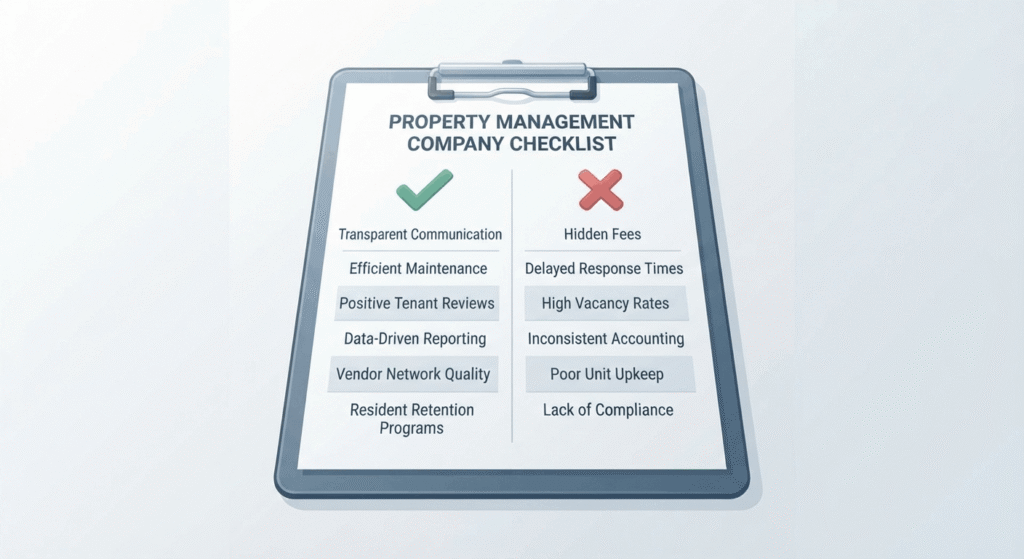
Fair housing compliance deserves extra attention. Every firm you consider should be able to explain, in plain language, how it follows the Fair Housing Act during marketing, screening, and leasing. Solid apartment management means judging every applicant against the same written standard, and a manager who gets this wrong can expose you to serious legal risk.
Frequently Asked Questions
1. How many property management companies should I interview before hiring one?
Interview at least three. Talking to multiple firms lets you compare fee structures, occupancy numbers, and communication styles side by side, and it gives you room to negotiate on price. Multifamily management fees are frequently negotiable, especially for larger portfolios, so a competing proposal in hand can save you real money every month.
2. What should a multifamily property management agreement include?
A clear agreement protects both sides. Before you sign, confirm it spells out:
- The exact management fee and every add-on charge
- The contract term and how either party can cancel
- Who holds security deposits and how trust accounts are handled
- Reporting frequency and owner portal access
- Maintenance approval limits and spending thresholds
3. Can I fire my property management company if I’m unhappy?
Yes, though the terms depend on your contract. Most agreements include a notice period, often 30 to 90 days, and some charge an early termination fee. Read the cancellation clause carefully before signing so you are not locked in. This is exactly why asking sharp questions up front saves money and stress later.
4. How much does it cost to hire a multifamily property management company?
Expect 4% to 7% of collected rent for larger multifamily buildings, or 8% to 12% for smaller ones, plus add-on fees for tenant placement, renewals, and maintenance markups. Some firms use a flat rate near $75 to $125 per unit instead. Always compare the total annual cost, not just the base percentage.
5. Is it worth hiring a property management company for a multifamily property?
For most owners with more than a few units, yes. A good property management company reduces vacancy, screens residents, keeps you compliant with fair housing law, and frees your time, which usually offsets the fee. Self-managing can work for small, local portfolios, but it gets harder as your unit count and distance from the property grow.
Conclusion
Hiring the wrong operator costs far more than a slightly higher fee ever will. The questions to ask before hiring a multifamily management company all point in one direction: get specifics in writing, verify credentials, and compare real numbers instead of sales talk. Bring this list to every interview, take notes on how directly each firm answers, and pick the one whose responses are clearest. To see how disciplined multifamily management should feel from an owner’s seat, talk with our team.