Quick Answer: Third-party apartment management cost in Texas typically runs 3% to 5% of collected income for full apartment communities and 8% to 12% of monthly rent for smaller rentals. Community size, service scope, and asset class set the rate. Leasing fees, maintenance markups, and renewal charges add to the headline percentage.
Hiring a management company is one of the largest recurring line items on a rental property’s budget, yet most fee quotes hide as much as they reveal. This guide breaks down third-party apartment management cost in Texas with real numbers, from a 300-unit community in Dallas-Fort Worth to a fourplex in San Antonio. Firms offering full-service apartment property management serve owners across Houston, Austin, San Antonio, and the DFW metroplex, where operating conditions differ from national averages.
What Is Third-Party Apartment Management Cost in Texas?
Third-party apartment management cost in Texas is the fee an owner pays an outside firm to run daily operations, usually charged as a percentage of collected income. Full apartment communities pay roughly 3% to 5% of effective gross income, while single rentals and small buildings pay 8% to 12% of monthly rent.
That gap surprises many first-time owners. It exists because a 250-unit community generates enough revenue that a small percentage still funds a full on-site team, while a duplex does not.
How Much Are Average Property Management Fees in Texas?
Average property management fees in Texas fall between 8% and 12% of monthly rent for single rentals and small properties, based on published rates from managers in Houston, Dallas, and Austin. Larger apartment communities pay far less as a percentage, typically 3% to 5% of collected revenue, because scale spreads the workload.
One data point makes the math concrete. A San Antonio owner with $30,000 in monthly collections at an 8% real estate management fee pays $2,400 per month. Move that same math to a 200-unit community collecting $300,000 and negotiate the rate down to 3.5%, and the fee is $10,500. Larger checks, smaller slice.
Property Management Rates by Community Size
Property management rates in Texas scale down as unit count climbs. Managers of communities with ten or more units in markets like San Antonio commonly quote 4% to 7%, and communities above 200 units often negotiate rates of 3% to 4% of collected revenue. Under 50 units, expect 5% to 7% because the manager needs a minimum fee to justify the engagement.
| Property size | Typical fee in Texas | Fee basis |
|---|---|---|
| Single rental to 20 units | 8% to 12% | Monthly rent |
| 20 to 100 units | 5% to 8% | Collected income |
| 100 to 200 units | 4% to 5% | Effective gross income |
| 200+ units | 3% to 4% | Effective gross income |
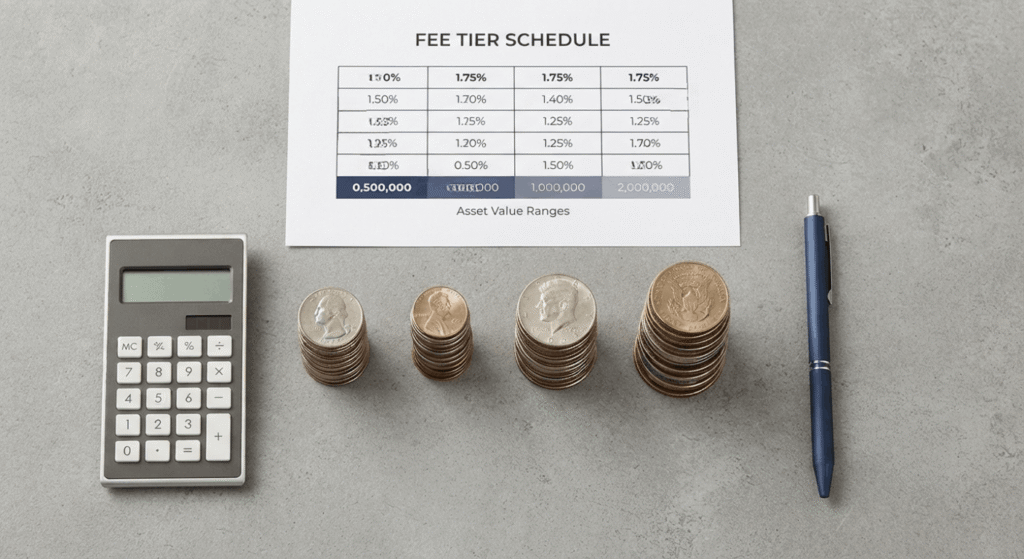
One caveat matters for anyone buying with debt. Fannie Mae and Freddie Mac lenders typically underwrite a 5% to 6% management fee floor on multifamily loans regardless of what you actually pay, or even if you self-manage. Your negotiated rate and your underwritten rate are two different numbers, and the lender’s version reduces the NOI used to size your loan.
What a Building Management Fee Should Include
A building management fee at a full-service firm should cover rent collection, resident communication, vendor coordination, monthly financial reporting, budget preparation, and compliance work. The stronger operators bundle vendor management, compliance, and the resident experience into the base fee rather than billing each piece separately.
Ask for the exclusion list in writing. Leasing commissions, renovation oversight (often 3% to 5% of project cost), and eviction processing are frequently billed on top, and those hidden charges can add 1% to 2% to your effective rate. A 3% contract that behaves like a 5% contract is common enough that experienced owners read the fee schedule before the marketing deck.
What Other Costs Are Associated With Being a Landlord in Texas?
The costs associated with being a landlord in Texas extend well past the monthly property manager cost. Owners also carry leasing fees, maintenance markups, marketing spend, renewal charges, insurance, and property taxes. Texas property taxes rank among the highest in the country, so the management fee is rarely the biggest line on the budget.
Typical property management fees also interact with vacancy. Every empty unit costs a full month of rent plus turn expenses, which is why demand generation held to a cost-per-lease standard, the model behind leasing and marketing programs built for apartment communities, often matters more to returns than shaving half a point off the base rate.
Typical Cost for Tenant Placement
The typical cost for tenant placement in Texas ranges from 50% to 100% of one month’s rent per new lease. One Austin firm publishes a 75% placement fee, which works out to $1,500 on a $2,000 rental. That fee covers marketing, showings, screening, and lease execution.
Placement pricing looks different at community scale. Larger apartment operators usually staff on-site leasing agents whose payroll runs through the property budget instead of per-lease commissions, one more reason multi-family community management pricing doesn’t map neatly onto single-rental fee sheets.
Renewal fees deserve a look too. Some contracts charge $150 to $300, or a percentage of rent, every time an existing resident signs again. On a stable community, renewal charges quietly compound.
Maintenance, Markups, and the Fine Print
Maintenance is where effective rates drift furthest from quoted rates. Many managers add a 5% to 15% markup on contractor invoices, and marketing can run $200 to $1,000 per vacant unit depending on the channel mix. Evictions add court costs plus service fees, and Harris County eviction timelines of 30 to 60 days mean lost rent stacks on top.
Texas also imposes a legal cost most owners overlook. Property management is regulated as brokerage activity here, so your manager must hold or operate under a Texas Real Estate Commission broker license and keep resident funds in compliant trust accounts. As of January 1, 2026, Senate Bill 1968 tightened those rules further, requiring every broker to complete the six-hour Broker Responsibility Course at each renewal. Fees collected by an unlicensed manager are collected in violation of state law, so verify the license before signing anything.

Frequently Asked Questions
1. How much does a property manager cost in Texas per month?
A property manager in Texas costs roughly $200 to $350 per month for a typical single rental, based on 8% to 12% of rent. Houston owners commonly pay $2,000 to $3,500 per year for full service. Apartment communities pay 3% to 5% of collected income, so a $300,000 monthly collection costs about $9,000 to $15,000.
2. What do typical property management fees in Texas include?
Most full-service agreements in Texas bundle these core services into the base fee:
- Rent collection and delinquency follow-up
- Resident communication and maintenance coordination
- Monthly financial reporting and budget preparation
- Lease compliance and fair housing adherence
Leasing commissions, renovation oversight, and eviction processing are usually billed separately, so request the full fee schedule.
3. How much is the tenant placement fee in Texas?
Tenant placement in Texas costs 50% to 100% of one month’s rent per new lease, with 75% being a commonly published rate in Austin. On a $2,000 rental, that means $1,000 to $2,000 upfront. The fee pays for professional photos, listing syndication, showings, income and background screening, and lease signing.
4. Do Texas property managers need a real estate license?
Yes. Texas regulates property management as real estate brokerage under Chapter 1101 of the Occupations Code, so a manager who leases and collects rent for others must hold or work under a TREC broker license. Senate Bill 1968, effective January 1, 2026, added a universal Broker Responsibility Course requirement at every renewal.
5. Is hiring third-party apartment management worth the fee?
For communities of 50 or more units, usually yes. Lenders often require professional management for multifamily loans, and Fannie Mae and Freddie Mac underwrite a 5% to 6% fee floor whether you self-manage or not. A capable operator also cuts vacancy and turnover, and a single bad tenant can cost $5,000 to $10,000 in total losses.
Conclusion
Third-party apartment management cost in Texas comes down to scale: 8% to 12% of rent for small properties, 3% to 5% of collected income for full communities, plus placement fees, markups, and renewal charges that determine your true effective rate. Compare fee schedules line by line, confirm the TREC broker license, and weigh what the fee buys in occupancy and compliance, not just what it subtracts from collections. For owners running communities in Dallas, Houston, Austin, or San Antonio, the right operator should be able to show you exactly where every dollar goes each month.