

Quick Answer: Switching management companies mid-lease-up is survivable when the handoff protects the lead pipeline, the concession schedule and the resident ledger. Signed leases, deposits and the rent roll carry over to the new operator. Leasing pace is what usually slips, and every lease that signs a month late costs the owner a month of rent.
What Does Switching Management Companies Mid-Lease-Up Involve?
Switching management companies mid-lease-up means replacing the operator of a new or repositioned community before it reaches stabilized occupancy. The owner ends one management agreement, starts another, and moves leasing, accounting, staffing and marketing to the new firm while units are still being absorbed and concessions are still in the market.
Owners rarely plan for switching management companies mid-lease-up. It usually follows a missed absorption target, or reporting that arrived too late to act on.
Why lease up apartments are more exposed than stabilized ones
A stabilized property can coast through a rough month. Lease up apartments can’t, because the building is carrying debt against units that produce no rent yet.
The backdrop is slower than most pro formas assumed. The Census Bureau’s Survey of Market Absorption shows 41% of apartments completed in the first quarter of 2026 were rented within three months, the seventh straight quarter under 50%. New buildings are taking longer to fill, so a stalled month hurts more than it did in 2021.
Supply is easing, though. Completions in buildings with five or more units ran at a 302,000 annual rate in August 2026, according to the Census Bureau and HUD new residential construction release. That helps only if the leasing office is at full speed when prospects arrive.

What Breaks in a Management Company Transition?
Three things break most often in a management company transition: the lead pipeline, the concession record and the accounting trail. All three live inside systems and accounts the outgoing firm controls, and none of them transfer automatically on the day the management agreement ends. Owners who are switching management companies mid-lease-up should secure each one before giving notice.
The apartment lease up strategy loses its pipeline first
Leads sit in the outgoing manager’s CRM. So do scheduled tours, applications in progress and the follow-up tasks attached to them. If that data isn’t exported before the cutover, the new team opens day one with an empty pipeline.
Marketing accounts are the second gap. Listing site contracts, paid search accounts, call tracking numbers and sometimes the property website are set up under the manager’s name. An apartment lease up strategy built on channels you can’t log into is on pause, so a plan for leasing and marketing continuity should be written before the termination letter goes out.
Lease up concession terms drift during the handoff
A lease up concession is only as good as its paper trail. Six weeks free, promised verbally by an agent who no longer works at the property, becomes a dispute on move-in day.
Concessions are heavy right now. RealPage reported roughly 17% of vacant units nationally offering concessions as of April 2026, the highest share since the early 2010s. In that market the new operator needs a unit-by-unit schedule showing what was promised, what has been credited and what is still owed.
Consistency matters for a second reason when switching management companies mid-lease-up. The Fair Housing Act prohibits discrimination in renting, as HUD’s Fair Housing Act overview explains. Two similar applicants quoted different specials in the same week is a pattern no owner wants to explain.

Ledgers, deposits and owner reporting
Resident ledgers move between software platforms in most transitions. Prepaid rent, deposits held and concession credits have to tie out to the dollar on both sides. When they don’t, the first month of financial reporting to ownership goes to reconciliation, and the lender’s package goes out late.
The table below ranks what is at risk when switching management companies mid-lease-up.
| Item | Transition risk | What protects it |
|---|---|---|
| Lead and tour pipeline | High | Full CRM export before cutover |
| Marketing and listing accounts | High | Owner-held logins and contracts |
| Concession schedule | High | Unit-by-unit written record |
| Resident ledgers and deposits | Medium | Tie-out signed by both firms |
| On-site staff | Medium | Early retention offers |
| Signed leases | Low | Leases run with the ownership entity |
What Doesn’t Break When Changing Property Management Companies?
Changing property management companies does not undo the work already done. Signed leases remain in force, deposits remain an owner obligation, and the rent roll, unit inventory and resident files stay with the property.
The property management lease stays with the owner
In most structures, the manager signs each lease as agent for the ownership entity. The property management lease is a contract between the resident and the owner, so a new operator inherits it as written, including rent, term and any concession spelled out in the document. Have counsel confirm this against your lease form and state law before notice goes out.
Stabilized occupancy targets don’t move either
Your lender’s definition of stabilized occupancy sits in the loan documents, and it doesn’t reset because the operator changed. MRI Software puts the usual benchmark at 90% to 95% occupied within 12 to 18 months of opening. Switching management companies mid-lease-up doesn’t pause that timeline.
How Should Owners Time an Apartment Management Transition?
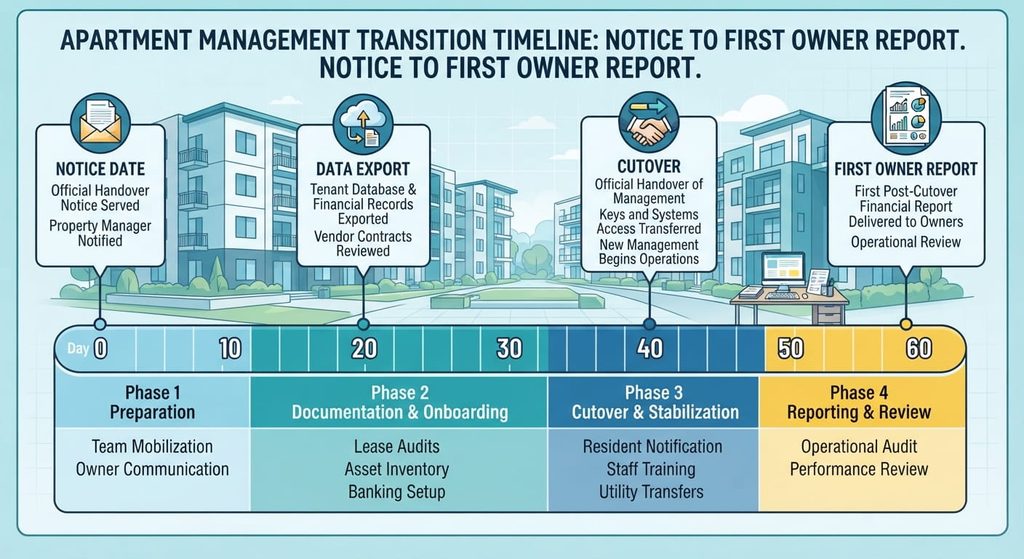
Owners should time an apartment management transition around leasing pace, giving notice only after the incoming firm has a written takeover plan. Cut over at a month end, with data exports, account ownership and staffing settled before the final 30 days begin.
Property management removal starts with the agreement
Property management removal is governed by the termination clause in the management agreement. Read it for the notice period, any termination fee and the records the manager must hand over. Many agreements say little about lead data and marketing accounts, which is where owners switching management companies mid-lease-up lose the most time.
What a stalled month costs
Switching management companies mid-lease-up has a price when it goes badly. Take a modeled 250-unit community absorbing 18 leases a month at $1,450 average rent. If the handoff stalls leasing for 30 days, 18 leases sign a month late. That’s $26,100 in rent the owner never collects, before interest carry on the construction loan.
Ask any incoming property management team how many leases it signed in the first 30 days of its last takeover.
Frequently Asked Questions
1. Is switching management companies mid-lease-up allowed?
Yes. An owner can replace the operator at any occupancy level by following the termination clause in the management agreement. The risk is higher than at a stabilized property, because leads, concessions and staffing are all in motion.
2. What happens to signed leases when the management company changes?
Signed leases generally stay in force. The manager typically signs as agent for the ownership entity, so the lease belongs to the owner and the new operator administers it as written. Rent, term and written concessions carry over.
3. How long does a management company transition take?
The timeline follows the notice period in the management agreement, so read that clause first. Switching management companies mid-lease-up needs a longer runway than a stabilized handoff, because pipeline data and concession records take time to verify.
4. Do residents keep their lease up concession after a management change?
A concession written into the lease or a signed addendum carries over with the lease. Verbal promises are the problem. Before switching management companies mid-lease-up, owners should request a unit-by-unit concession schedule and compare it with the signed documents, so credits still owed are honored and nothing is paid twice.
5. What should owners collect before changing property management companies?
Request these items in writing before the cutover date:
- Full lead, tour and application export from the leasing CRM
- Logins and contracts for listing sites, paid media and the property website
- Resident ledgers, deposit balances and the concession schedule
- Vendor contracts, warranties and utility account details
- Staff roster with pay rates and hire dates
Conclusion
Switching management companies mid-lease-up breaks whatever the owner doesn’t control: lead data, marketing accounts and the concession record. Leases, deposits and the lender’s stabilization target hold. Secure the first group before giving notice. AAM Living manages market-rate apartment communities through lease-up and stabilization.