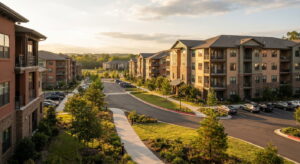

Quick Answer: The Build-to-Rent Lease-Up Playbook is the operating plan that takes a new BTR community from zero residents to stabilized occupancy. It sets pre-leasing timing against the certificate of occupancy calendar, defines concession structure, staggers lease terms to prevent an expiration cliff, and assigns weekly absorption targets the leasing team owns.
What is the build-to-rent lease-up playbook?
The build-to-rent lease-up playbook is a sequenced plan covering marketing launch, pricing, staffing, and lease-term structure for a brand-new rental community. A lease-up starts with no rent roll and no resident reviews. Every assumption written into the pro forma gets tested inside the first 12 months of operation.
Scale matters. About 62,000 single-family built-for-rent homes started construction over the four quarters through Q1 2026, a 26% drop from the prior 84,000, per NAHB’s analysis of Census Bureau starts-by-purpose data. Thinner future supply helps. It does nothing for the community handing over keys this quarter.
Why the build to rent concept changes lease-up math
The build to rent concept puts detached homes, townhomes, or cottages under single ownership and one operator, so a community delivers in pods instead of all at once. Certificates of occupancy arrive in waves. Leasing runs against that schedule, not against a single opening date.
Phasing is the biggest structural break from a mid-rise. A 180-home community might release 24 homes in March, 40 in June, and the balance across the following two quarters. Marketing spend, model readiness, and staffing all move with the CO calendar. Front-load the entire budget at launch and you’ll be out of money by the phase that actually needs it.
Build to rent investment underwriting usually assumes stabilization somewhere between month 12 and month 18. Construction delays push that out. Managing purpose-built single-family rental communities at scale means treating each delivery pod as its own mini lease-up with its own absorption target.
How early should build to rent marketing start?
Build to rent marketing should begin 9 to 12 months before the first certificate of occupancy, well before any model is furnished. That window covers brand and website build, listing syndication setup, interest-list capture, and local partnerships. Waiting until homes are finished costs weeks of absorption nobody recovers later.
Interest lists are the cheapest lease source a lease-up ever gets. A prospect who signs up seven months early costs almost nothing to re-engage. That same lead bought through paid search in month four of leasing costs real money per signed lease.
One compliance point deserves attention before any campaign goes live. HUD’s Fair Housing Act requirements apply to advertising, targeting, and application handling, including automated ad-delivery tools. Audience exclusions on social platforms are where lease-up teams most often create exposure without realizing it. Demand generation held to a cost per lease should be reviewed for fair housing compliance at campaign setup, not after a complaint lands.
What absorption pace should a rental community lease-up target?
A rental community lease-up in 2026 should plan for slower absorption than 2021-era pro formas assumed. Census Bureau Survey of Market Absorption data shows 49% of new apartments completed in Q4 2025 were rented within three months, the sixth straight quarter under 50%. Twelve-month absorption reached 90%.
Those figures are the honest baseline for multifamily lease up planning. A build-to-rent lease-up playbook built on 2021 velocity misses badly. BTR behaves somewhat differently: Yardi Matrix reported purpose-built BTR occupancy holding in the mid-90s at the end of 2025, with advertised rents essentially flat year over year.
| Lease-up milestone | Typical BTR target | National apartment benchmark |
|---|---|---|
| Months 1 to 3 after CO | 30% to 40% leased | 49% absorbed at 3 months |
| Months 4 to 6 | 55% to 65% leased | 68% absorbed at 6 months |
| Months 7 to 9 | 75% to 85% leased | 80% absorbed at 9 months |
| Months 10 to 12 | 90% or better | 90% absorbed at 12 months |
| Stabilized occupancy | 93% to 96% | 7.3% national rental vacancy |

Apartment benchmarks come from the Census Bureau SOMA release covering Q4 2025 completions. The vacancy figure is the Q2 2026 Housing Vacancy Survey reading.
Concessions and the lease expiration trap in BTR development
Concessions are standard in most BTR development markets now. How the concession is structured matters more than its size, which is why every build-to-rent lease-up playbook fixes structure first. John Burns research cited by Builder magazine put stabilized BTR communities at close to one month of free rent, with lease-ups running higher. A concession preserves the face rent used for valuation. A rate cut does not.
Here’s the part most lease-up plans miss. Sign every early resident to a straight 12-month term and roughly 40% of the community expires inside the same 60-day window a year later. That expiration wall arrives exactly when the concession burns off and renewal increases are hardest to defend.
Price 9, 13, 15, and 18-month terms differently from day one. Spreading initial expirations across eight or nine months costs a little effective rent up front and saves far more in year-two turnover. Turnover in premium BTR communities already runs below conventional apartments, and protecting that edge starts with the first lease signed.
How does BTR property management differ from multifamily lease up?
BTR property management spreads the same unit count across 20 or 30 acres instead of stacking it inside one building. Tours take longer. Maintenance techs drive between addresses. Punch-list and builder-warranty work overlaps with occupied homes for months, which almost never happens in a finished mid-rise.
What BTR community management should report weekly
Effective BTR community management tracks a short list of numbers every Monday during lease-up:
- Net leases signed against the phase target, not cumulative occupancy
- Cost per lease by source, split between interest list, paid search, and ILS
- Effective rent after concession, measured against underwriting
- Lease expiration distribution by month for the next 18 months
- Open builder-warranty items in delivered homes

Tie those to budgeting and live owner reporting so ownership sees absorption and spend in one view. When a phase misses target two weeks running, the cause is usually pricing or lead volume, and the report should say which. Full-cycle operations and resident experience carry the plan past stabilization.
Frequently Asked Questions
1. How long does a build-to-rent lease-up take?
Most BTR communities plan for 12 to 18 months from first certificate of occupancy to stabilized occupancy. Phased delivery stretches that timeline, since later pods begin leasing months after the first. Census SOMA data shows 90% of new apartments absorb within 12 months nationally.
2. Is build-to-rent still a good investment in 2026?
Build to rent investment fundamentals held up through the 2025 supply wave. The Census Bureau reported a 7.3% national rental vacancy rate in Q2 2026 and a 65.0% homeownership rate, so renter demand stayed intact. Underwriting now needs today’s rents to pencil, not projected growth.
3. What occupancy counts as stabilized for build to rent communities?
Most lenders and operators treat 93% to 95% physical occupancy sustained for 90 days as stabilization. Some loan documents add a debt service coverage test on top. Confirm the exact definition in your construction loan before setting leasing bonus targets.
4. Should a BTR lease-up offer concessions or lower the rent?
Concessions usually beat rate cuts during lease-up, for four reasons:
- Face rent stays intact for appraisal and refinance
- The incentive expires, while a rate cut is permanent
- Concessions can be tied to specific move-in windows
- Renewal conversations start from a higher base rent
5. Who should manage a BTR community during lease-up?
Lease-ups need an operator with new-construction experience, not just stabilized-asset staffing. The team handles builder warranty coordination and phased CO turnovers while leasing aggressively. Ask any prospective manager to walk you through their build-to-rent lease-up playbook and share absorption results from their last two lease-ups.
Conclusion
The Build-to-Rent Lease-Up Playbook is not a marketing document. It’s an operating schedule connecting the CO calendar, the concession structure, the lease-term ladder, and the weekly absorption target into one plan a site team can actually run. Communities that write it early and hold to it stabilize on time. The ones that improvise tend to discover the gap around month nine, when the marketing budget is spent and 40% of the rent roll expires in a single quarter.
AAM Living manages build-to-rent communities through lease-up and past stabilization. Talk to our team about an absorption plan for your next delivery.